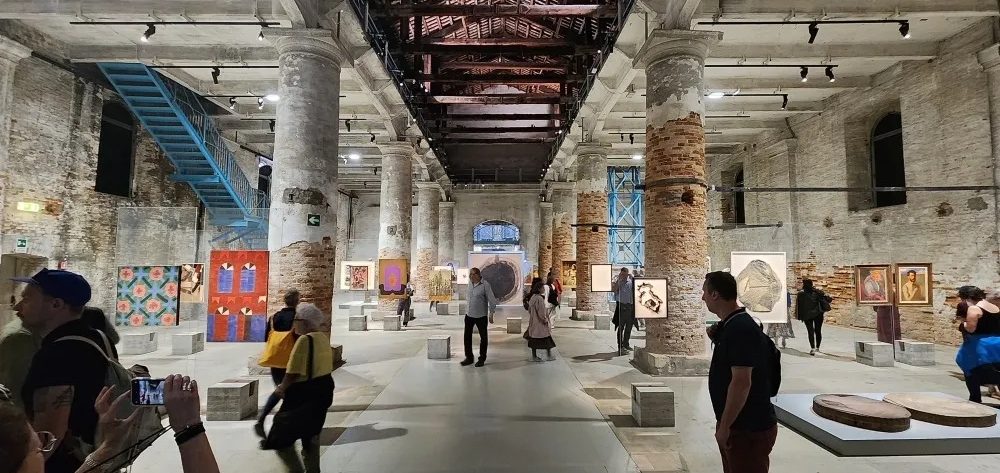
The 60th Venice Biennale Celebrates Foreigners. Image courtesy by Jennifer Pratt Mead.
Building trusted global platforms for contemporary art
RFA Projects supports artists and institutions in presenting their work on the world’s most eminent platforms for contemporary art. Through a combination of curatorial expertise, strategic guidance, and an international network of partners, we accompany artists and organizations from concept development to exhibition realization.
In this section, we present a curated selection of exhibitions, museums, and biennales from the contemporary art world initiated and organized by RFA Projects, while others emerge through close collaboration with leading museums, biennales, and cultural institutions worldwide. Additional exhibitions are included as reference points, illustrating the range of contexts and possibilities in which artists may position their work. Our role is to connect artistic vision with the appropriate context, enabling works to reach significant audiences and resonate within the global art discourse.
LA BIENNALE DI VENEZIA
May 9 – November 22, 2026
61th Edition 'In Minor Keyes'
National pavilions and cultural representations
The Venice Biennale stands as one of the most enduring and influential platforms in the history of contemporary art. Structured around a constellation of national pavilions alongside a central international exhibition, the Biennale offers a unique framework in which countries articulate cultural identity, critical discourse, and artistic vision on a global stage.
Beyond direct invitations, several national pavilions operate through Open Calls, inviting artists, curators, and interdisciplinary teams to propose concepts for representing their countries at the Biennale. Nations such as Malta, Scotland, Cyprus, Australia, and others regularly activate these open selection processes, fostering transparency, diversity of voices, and rigorous public debate around cultural representation. These calls often emphasise curatorial clarity, conceptual depth, and the ability to respond meaningfully to both local contexts and international audiences.
This model transforms the national pavilion into a site of research and reflection rather than mere display. Proposals frequently engage with questions of history, identity, geopolitics, ecology, and the evolving role of the nation-state within a globalised cultural landscape. In this sense, the pavilion becomes a discursive space—one that negotiates between artistic autonomy, institutional responsibility, and public accountability.
RFA Projects has supported artists and curators throughout the development of proposals and concepts for national pavilion calls, accompanying them from early-stage concept formation to the articulation of cohesive exhibition narratives. This support focuses on strengthening curatorial frameworks, refining artistic strategies, and aligning proposals with the specific architectural, historical, and political conditions of each pavilion. Particular care is given to articulating how individual practices can speak on behalf of broader cultural experiences without collapsing into fixed or reductive identities.
Through this process, RFA Projects acts as a critical interlocutor between artistic vision and institutional expectation, enabling projects that are both contextually grounded and internationally resonant. Engaging with the Venice Biennale allows artists and curators to enter one of the world’s most visible exhibition platforms while maintaining intellectual independence and conceptual integrity.
By supporting practices that emerge from open, competitive, and reflective selection processes, RFA Projects contributes to a broader understanding of the Venice Biennale as a dynamic ecosystem—one shaped not only by established voices, but by proposals that question, expand, and reimagine what national representation can be today.
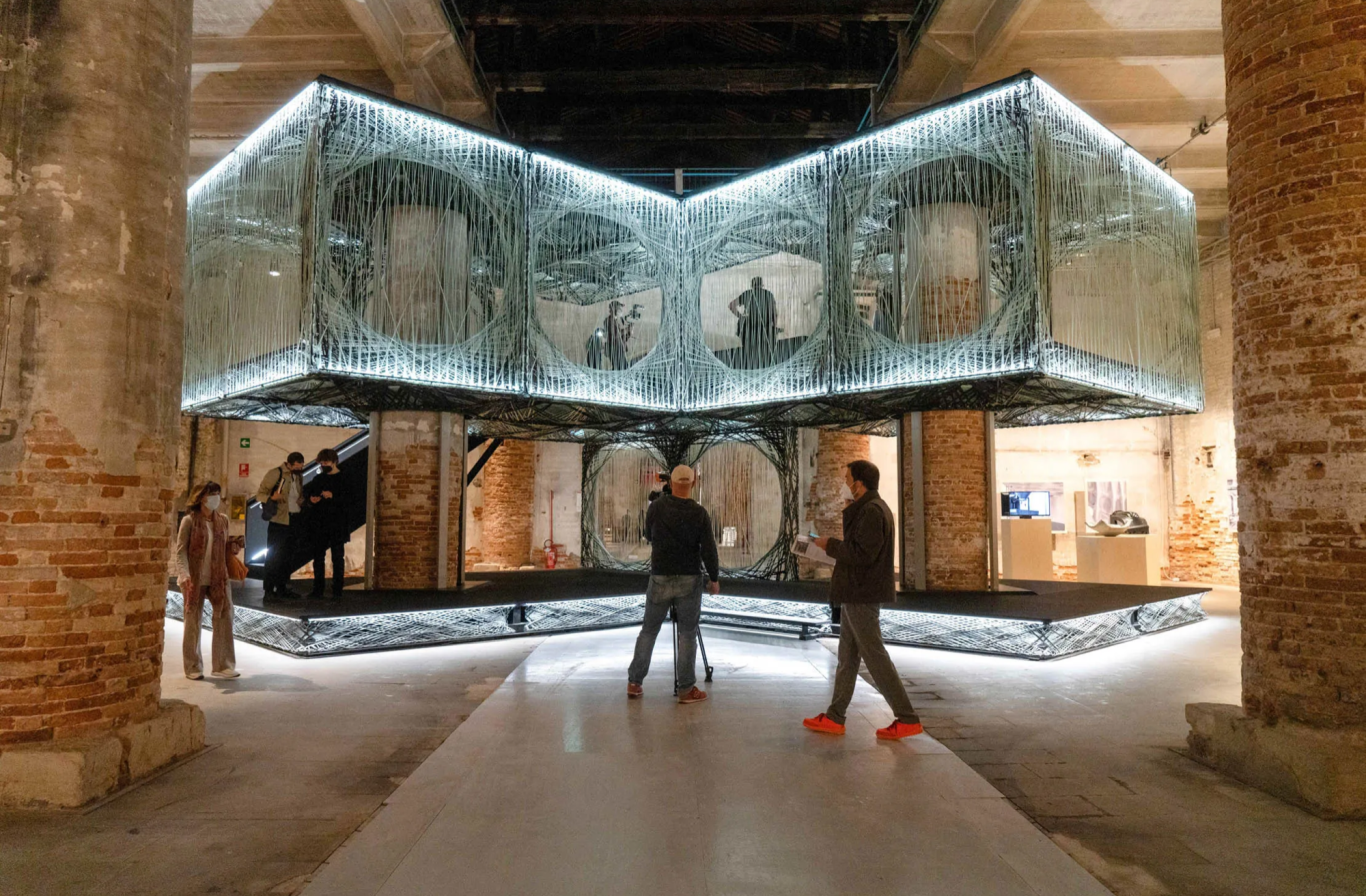
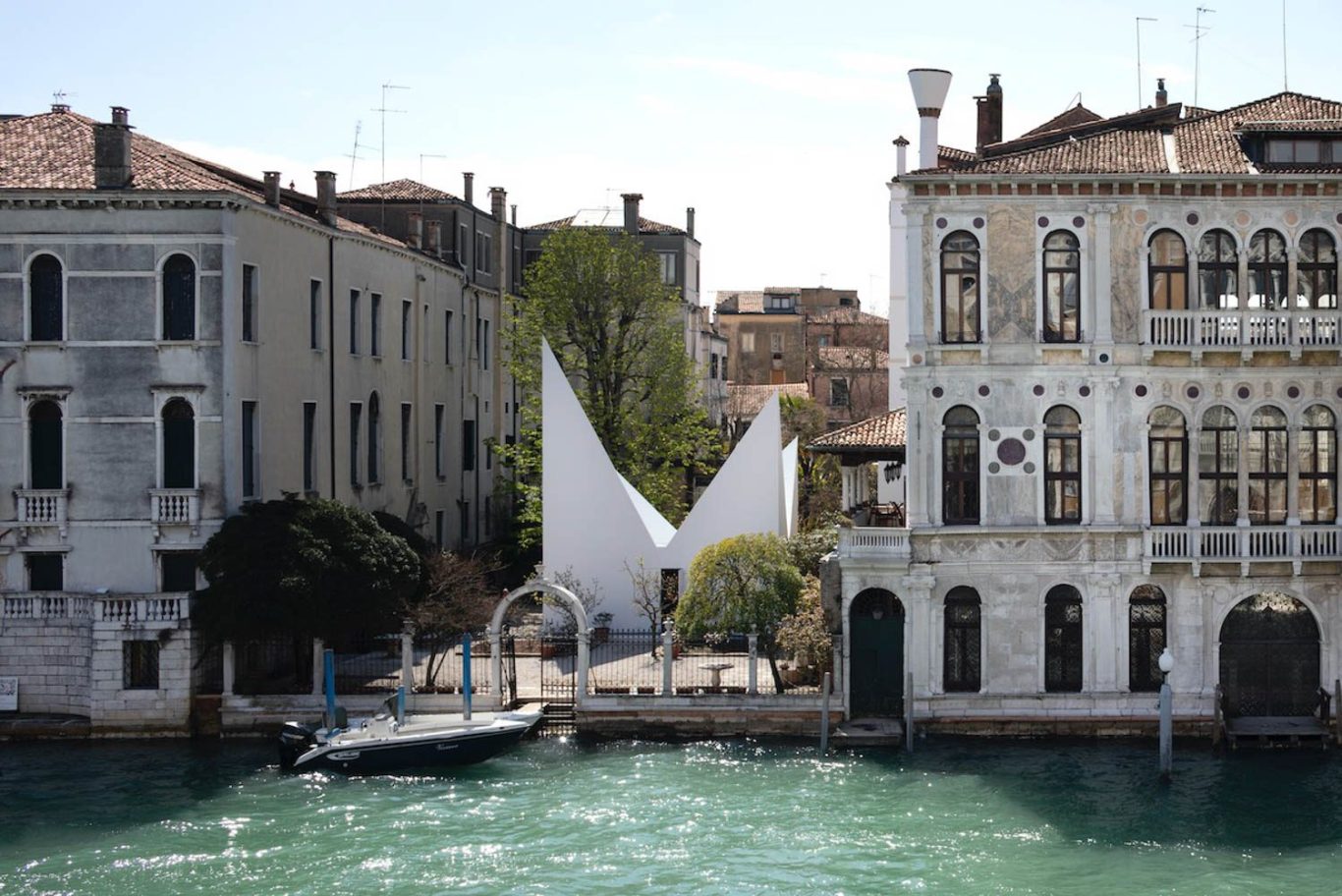
Images: (1) Hanji House, photo by Alice Clancy, courtesy of CKY Studio. (2) The Arsenale in Venice, installation by the University of Stuttgart's Institute for Computational Design and Construction and Institute of Structural Design. Photographer: Giulia Marchi/Bloomberg.
MUSEUM OF MODERN ART BARCELONA
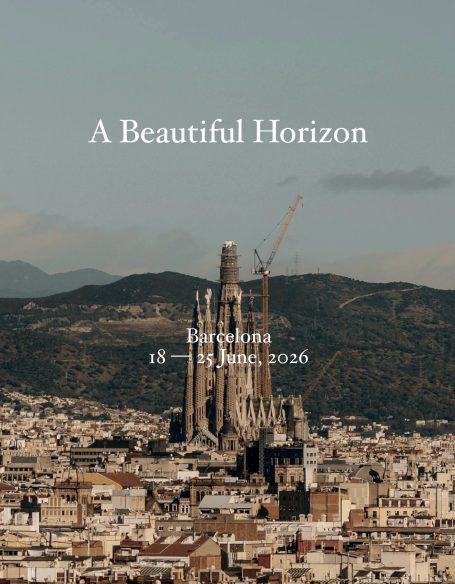
A Beautiful Horizon
18–25 June, 2026
A Beautiful Horizon arrives to Barcelona, bringing together a carefully selected group of contemporary artists within one of Europe’s most distinctive museum spaces.
Museum Introduction
The exhibition organized by RFA Projects, takes place at the Museu Europeu d'Art Modern (MEAM), one of the city’s most distinctive cultural institutions dedicated to figurative and contemporary art. Located in the historic heart of Barcelona, the exhibition unfolds inside a museum where tradition and contemporary vision meet in dialogue. Surrounded by the architectural memory of the city and the atmosphere of Mediterranean light, the works presented here explore new perspectives in contemporary artistic practice.
A Beautiful Horizon invites visitors to encounter powerful and forward-looking works while reflecting on the evolving landscape of contemporary art.
Alongside the exhibition program, A Beautiful Horizon invites artists to share their work and become part of future editions and curatorial projects. We welcome submissions from contemporary artists working across painting, sculpture, photography, and interdisciplinary practices whose work engages with the evolving language of contemporary art.
Selected artists will be considered for upcoming exhibitions, collaborations, and curatorial initiatives connected to our international program. This open call is designed to create meaningful opportunities for artists to present their work within a professional museum context and to enter into dialogue with a wider global audience.
A horizon is not only something we observe — it is something we move toward together.
Artists are invited to submit their proposals through the link below.
Curator’s Note
A Beautiful Horizon brings together a selection of contemporary artists whose works explore the shifting boundaries of perception, memory, and place.
Presented within the historic spaces of the European Museum of Modern Art, the exhibition creates a dialogue between tradition and the evolving language of contemporary art. Each work contributes to a broader reflection on how artists respond to the present moment while imagining new horizons for the future.
Rather than presenting a fixed narrative, the exhibition opens a field of perspectives — where individual voices meet within a shared space of inquiry, imagination, and artistic vision.
Apply Now
Artists interested in participating in this exhibition, or in ourfuture exhibitions and curatorial programs are invited to submit their work through the open call. Selected proposals will be reviewed by our curatorial team for upcoming projects and exhibition opportunities.
Submit your proposal and become part of the next horizon.
ROYAL SCOTTISH ACADEMY
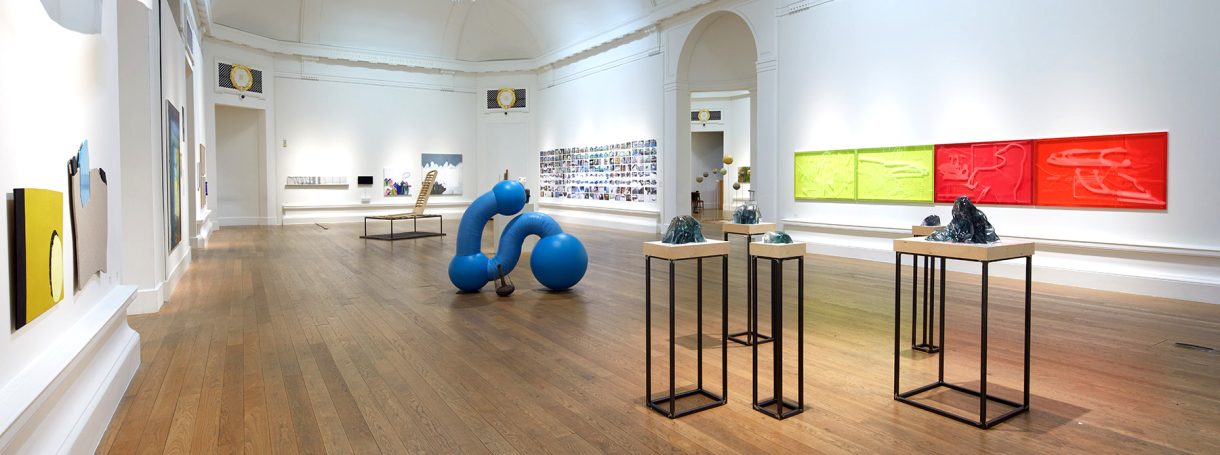
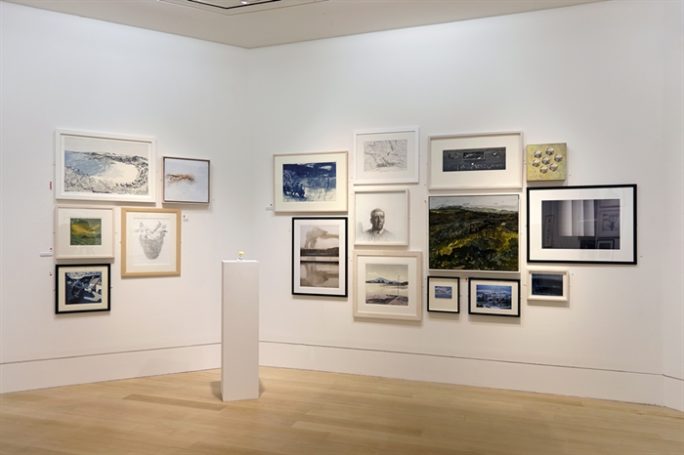
January 11 – February 4, 2026. Image courtesy: SSA and Royal Scottish Academy
127th Annual Exhibition SSA
It accumulates, listens, and opens forward
From January 11 – February 4, 2026, the Society of Scottish Artists presents its 127th Annual Exhibition in the Upper Galleries of the Royal Scottish Academy, Edinburgh. More than a recurring event, this edition unfolds as a moment of alignment: the SSA entering its 135th year, and the RSA marking two centuries of artistic stewardship. Time here is not commemorated as past, but activated as structure.
The exhibition situates contemporary practice within a long architectural lineage. The Upper Galleries become a site where generations speak across distance — not in opposition, but in continuity. What emerges is not nostalgia, but recognition: that artistic culture survives through transmission, not repetition.
As part of the RSA 200 celebrations, the SSA honours its lifelong association with the Academy by exhibiting three works from the RSA collection, created by its first three presidents: Robert Noble RSA, Robert Buchan Nisbet RSA, and James Cadenhead. These works do not stand as monuments; they function as anchors. Their presence affirms that foundations are not static — they are meant to support new weight.
Within this framework, the 127th Annual Exhibition asserts the role of the artist society as both guardian and conduit. The SSA does not merely preserve legacy; it maintains a living threshold where historical gravity and contemporary urgency meet. Here, tradition is not an enclosure. It is an aperture. A structure that allows the future to pass through with form.
ECHIGO-TSUMARI ART FIELD
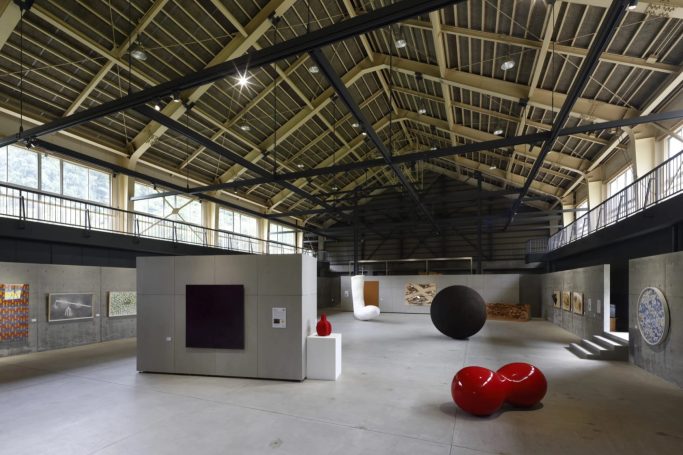
Photo: Kioku Keizo
Art as Guiding Light
Echigo-Tsumari Triennale 2027
Since its inception in 2000, the Echigo-Tsumari Art Triennale has stood as a pioneer of regional art festivals in Japan and one of the largest art events worldwide. Set within the Echigo-Tsumari Art Field in Niigata Prefecture, the triennale unfolds across a rural landscape shaped by heavy snowfall, ageing communities, and depopulation—yet still deeply rooted in satoyama life, where people and land remain intimately connected.
Artworks are installed throughout fields, forests, villages, schools, and abandoned structures, transforming the region into a living exhibition where art functions as a guiding light—leading visitors through nature, memory, and shared experience. Moving slowly between sites becomes part of the encounter: walking, driving, and listening to the land are as essential as viewing the works themselves.
More than a temporary exhibition, the Echigo-Tsumari Art Triennale proposes an alternative model for contemporary art—one grounded in duration, care, and coexistence. Many works remain permanently in place, forming an evolving constellation that can be encountered year-round, long after the festival season ends. Artists collaborate closely with local residents, embedding stories, labour, and daily rituals into the fabric of the artworks.
Held every three years, the triennale has gained international recognition as a leading example of art-led community building. Previous editions have welcomed hundreds of thousands of visitors from Japan and abroad, generating sustainable economic impact while fostering cultural exchange across generations and geographies. As it returns in 2027, the Echigo-Tsumari Art Triennale continues its long-standing dialogue between art, land, and life—affirming art not as spectacle, but as presence, continuity, and shared future.
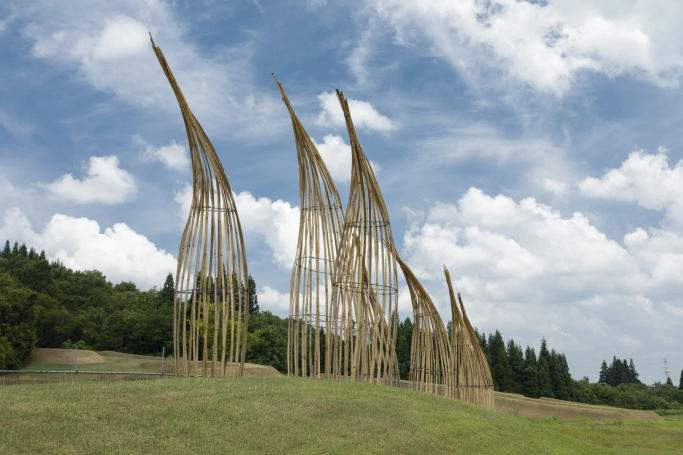
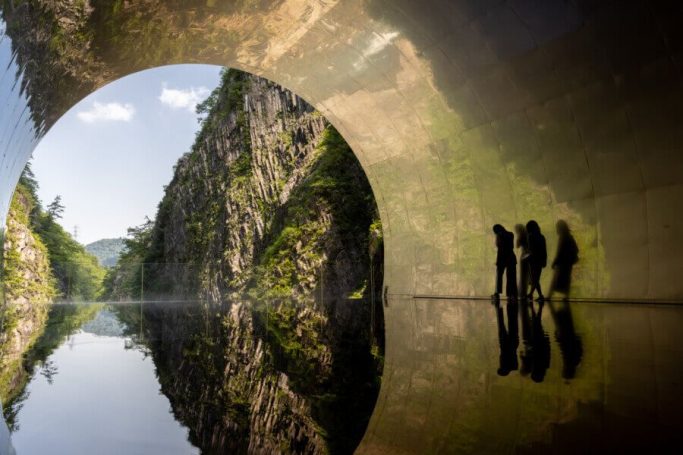
Images: (2) Utsumi Akiko, Winds on Field, courtesy of artist and Echigo-Tsumari Art Triennale. (3) Installation view, Tunnel of Light, 2018, courtesy of MAD Architects and Echigo-Tsumari Art Triennale.
FONDAZIONE PRADA MILAN
December 4, 2025 – October 30, 2026
The Island
Hito Steyeril
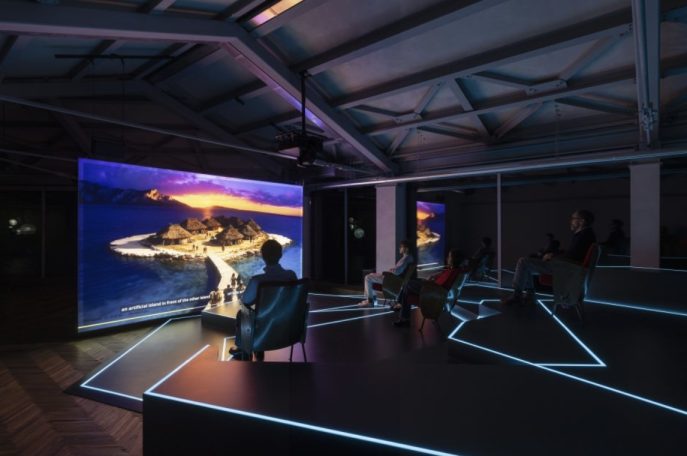
“The Island” is a site-specific project by Hito Steyerl presented at Osservatorio in Galleria Vittorio Emanuele II, Milan. In this work, Steyerl navigates overlapping narratives anchored by the recurring motif of flooding, evoking pressing issues such as authoritarian trends amplified by AI, climate instability, and political pressures on science. Central to the exhibition is a new film created by the artist, which converges into a video installation accompanied by a constellation of objects, structures, and interviews.
Steyerl’s practice (b. 1966, Munich, Germany) merges artistic production with theoretical inquiry, investigating socio-political, technological, and cultural systems. Her work examines the circulation of images, the power of media, and the ambivalence of science, often occupying the intersection of documentary film, experimental cinema, and spatial-digital installation.
The inspiration for “The Island” traces back to an anecdote shared by literary critic Darko Suvin (b. 1930, Zagreb, Croatia). During a 1941 bomb attack in Zagreb, Suvin imagined himself within the 1938 sci-fi serial Flash Gordon’s Trip to Mars, where the comic-book hero saves Earth. Steyerl reflects: “In any situation, other worlds were possible. Science fiction allows us to create parallel realities under extreme conditions… visually implemented here through quantum technology, where multiple states coexist and sudden leaps occur.”
The exhibition unfolds across four interrelated narratives — “Lucciole,” “The Artificial Island,” “The Birth of Science Fiction,” and “Flash!” — orchestrated through dimensional leaps reminiscent of both science fiction and quantum physics: from microorganisms to galaxies, Neolithic landscapes to the future, and literary narrative to AI-generated imagery. By blending fiction, scientific data, and popular culture, Steyerl constructs a space where contradictory worlds coexist and challenge perception.
“The Island” juxtaposes two notions of time: the relentless “junk time” of technology and capitalism, with its loops and interruptions, against deep, non-human temporalities — Neolithic, aquatic, and cosmic. The result is an exhibition that stretches beyond conventional chronology, where viewers encounter a universe of possibilities, reflection, and temporal multiplicity.
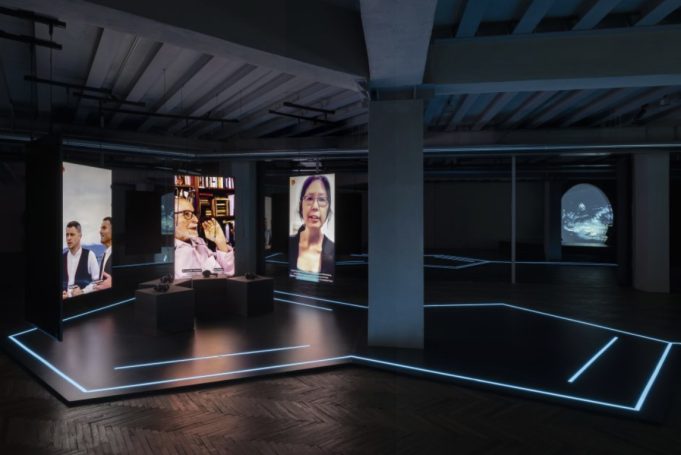
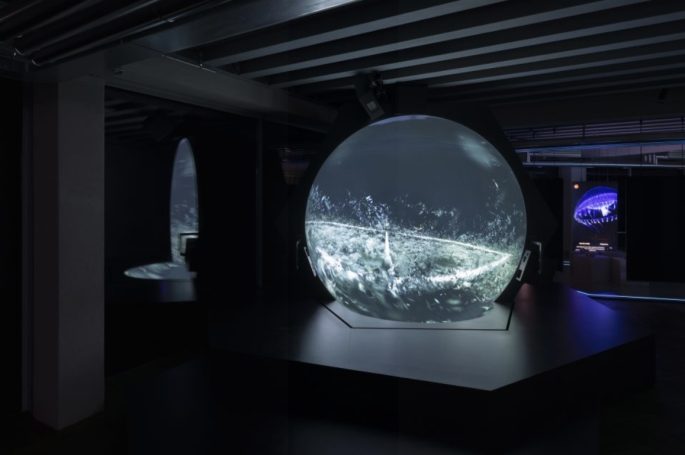
Images:The Island by Hito Steyerl, Osservatorio Fondazione Prada, Milan. Photo: Andrea Rossetti,
Courtesy Fondazione Prada © All rights reserved.
BIENAL SAO PAULO
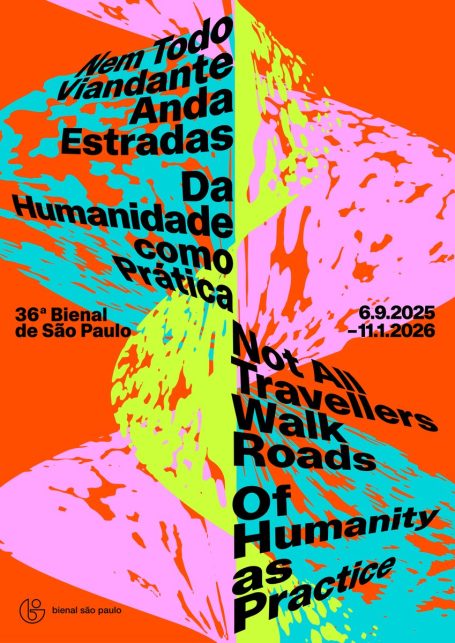
September 6, 2025 – January 11, 2026
Not All Travellers Walk Roads
36th Bienal de Sao Paulo
The 36th Bienal de São Paulo unfolds as a meditation on movement beyond geography. Not All Travellers Walk Roads proposes travel as a condition of thought, memory, ancestry, and resistance—paths traced through time, bodies, and belief rather than maps.
Across generations and geographies, the participating artists reflect on displacement and return, on knowledge carried orally, spiritually, and politically. Here, migration is not only physical but epistemic: ways of knowing that survive rupture, colonisation, and silence. The Bienal becomes a field of crossings—between ritual and contemporary gesture, archive and invention, the visible and the inherited.
São Paulo, a city shaped by continuous arrival, serves as both host and metaphor. The exhibition resists linear narratives, inviting visitors to wander through constellations of practices where care, ecology, and collective memory form alternative routes forward.
This edition affirms the Bienal as a space not of spectacle, but of passage—where art listens, carries, and remembers. Where movement becomes meaning, where the journey is the work. Here, the curatorial vision acts less as an authoritative frame and more as a porous guide—one that privileges listening over declaration. Rather than imposing a single thesis, the Bienal’s curators assemble a polyphonic structure, allowing divergent voices, temporalities, and cosmologies to coexist. The exhibition is conceived as an ecosystem: works respond to one another, contradict, echo, and remain unresolved. Meaning emerges through proximity and friction, not hierarchy. Not All Travellers Walk Roads challenges Western ideas of progress, authorship, and linear time. It proposes knowledge as something circular, relational, and embodied—transmitted through gesture, ritual, and lived experience. Art becomes a vessel for ancestral intelligence and speculative futures alike, where the spiritual and the political are inseparable. The Bienal asks not what art represents, but what it sustains.
The exhibition affirms art as a civic act. It foregrounds practices rooted in community, care, and collective survival, addressing histories of extraction, inequality, and erasure without reducing them to didactic statements. In doing so, it repositions the Bienal as a shared space of responsibility—where artists, curators, and audiences participate in reimagining how we move together in a fractured world.
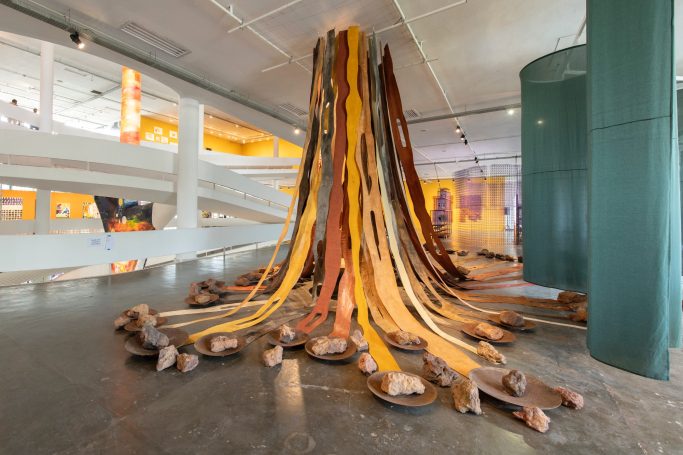
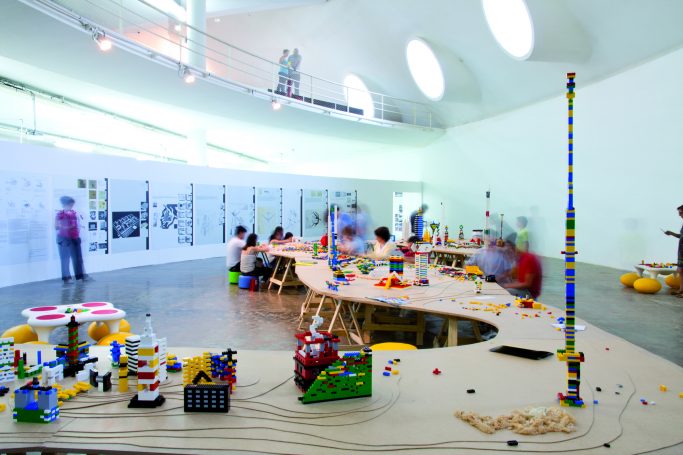
Images: Official poster 36th Bienal de Sao Paulo, design by Studio Yukiko. (2) Installation view Marlene Almeida (Levi Fanan / Fundacao Bienal). All images are courtesy of Bienal de Sao Paulo and Fundacao Bienal.
CAYMAN ISLANDS NATIONAL GALLERY
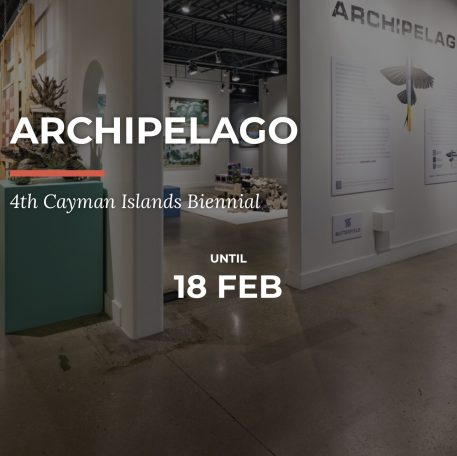
October 2, 2025 – February 18, 2026
Archipelago
Cayman Islands Biennial – 4th edition
With its fourth edition, the Cayman Islands Biennial expands its horizon, inviting curators Joseph L. Underwood and Davin Ebanks to conceive Archipelago, a multi-sited exhibition that reflects the complexity, diversity, and interconnectedness of Caymanian artistic practice. Presented by the National Gallery of the Cayman Islands, the biennial brings together outstanding submissions from artists across Grand Cayman, Little Cayman, Cayman Brac, and the Caymanian Diaspora, offering a panoramic view of contemporary cultural expression in the Caribbean.
Running from October 2, 2025 to February 18, 2026, with a Press and VIP Preview on October 1, the exhibition unfolds across a constellation of venues that mirror its thematic framework. Alongside the National Gallery, works are presented at the Cayman Islands National Museum, Gram Bella’s, the Mission House on Grand Cayman, the Little Cayman Museum, and Brac Heritage House. Admission to all sites and accompanying public programs is free, reinforcing the biennial’s commitment to accessibility, dialogue, and shared cultural space.
The title Archipelago draws inspiration from the geographic reality of island life—scattered yet interdependent, autonomous yet bound by invisible currents. Within this framework, the exhibition foregrounds the dynamic relationship between the individual and the collective, examining how identities are formed, challenged, and sustained within and across communities. Like islands themselves, the artists’ voices stand distinct, while together forming a living, evolving whole.
The exhibition is structured around a series of interconnected subthemes. Culture Shift explores heritage, memory, and belonging, tracing how traditions are carried forward, transformed, or contested. Social Dynamics addresses the forces shaping contemporary life, from communication and technology to politics and systems of power. Ecological Legacies considers the fragile relationship between land and people, engaging questions of sustainability, preservation, and environmental responsibility—concerns that resonate deeply within island contexts.
Through its multi-sited format and thematic depth, Archipelago positions the Cayman Islands Biennial as both a mirror and a meeting point: a space where local narratives engage global conversations, and where art becomes a connective tissue across geography, history, and lived experience.
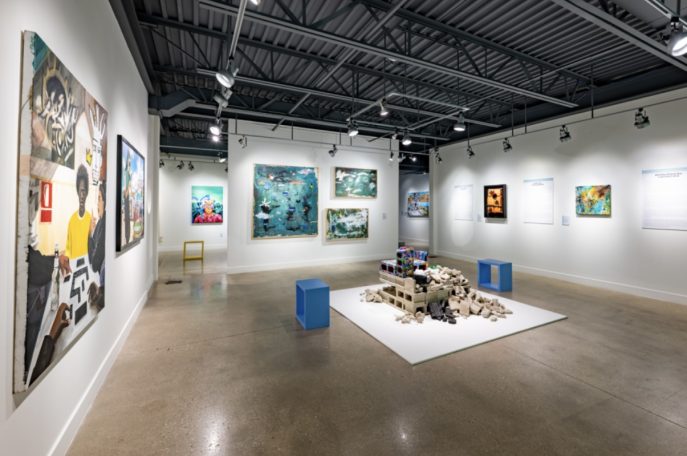
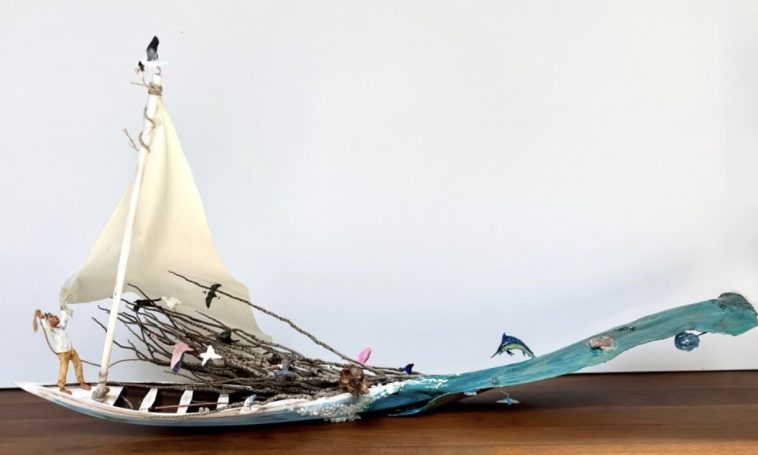
Images: (1) Archipelago (2) Installation view.(3) Christy Capewell, Making Way, 2025. All images are courtesy of Cayman Islands National Gallery and of the artists © All rights reserved.
MANIFESTA BIENNIAL
June 21 – October 4, 2026
Expanding the Exhibitionary Field
Manifesta 16 Ruhr
Manifesta, the European nomadic biennial, has long positioned itself as a laboratory for artistic, social, and political inquiry. Relocating to a new host city every two years, it engages local and international audiences through artistic projects, urban experiments, architectural interventions, and educational programmes. Beyond its central curatorial framework, Manifesta extends its reach through Open Calls, selecting additional projects that broaden and deepen the exhibition’s intellectual and geographic landscape.
These Open Calls function as porous thresholds: spaces where artists, collectives, and local initiatives can enter the biennial’s ecosystem with site-responsive, research-driven, and socially engaged proposals. The selected projects are not conceived as peripheral additions, but as integral contributions to Manifesta’s discursive fabric—amplifying plural voices, methodologies, and forms of knowledge production.
RFA Projects has supported artists throughout the development of their submissions, accompanying them from early conceptual articulation to the refinement of proposals aligned with Manifesta’s curatorial, ethical, and contextual frameworks. This support focuses on clarifying artistic intent, strengthening research foundations, and articulating meaningful relationships between concept, site, and community. Particular attention is given to practices engaging with collective memory, urban transformation, and contemporary forms of coexistence.
This approach finds a resonant context in Manifesta 16 Ruhr, taking place from 21 June to 4 October 2026 across the Ruhr Area, including Duisburg, Essen, Gelsenkirchen, and Bochum. Developed through extensive pre-biennial research and citizen consultations, Manifesta 16 proposes an Urban Vision for this polycentric, post-industrial, and highly diverse region. Central to this vision is the transformation of vacant post-war church buildings into communal spaces for dialogue, learning, and artistic experimentation.
Within this framework, the Open Call “This is not a church” has selected 16 additional projects that will activate former churches across the Ruhr Area as spaces of gathering and collective practice. Grounded in local realities and developed in close collaboration with neighbourhoods, these projects exemplify Manifesta’s long-term commitment to co-production and sustainable cultural legacies.
By engaging with Manifesta’s Open Calls—past, present, and forthcoming—RFA Projects continues to support artists navigating complex exhibitionary systems, fostering practices that are context-aware, socially embedded, and conceptually resilient. The exhibition here becomes not a fixed format, but a living structure—open, transformative, and shared.
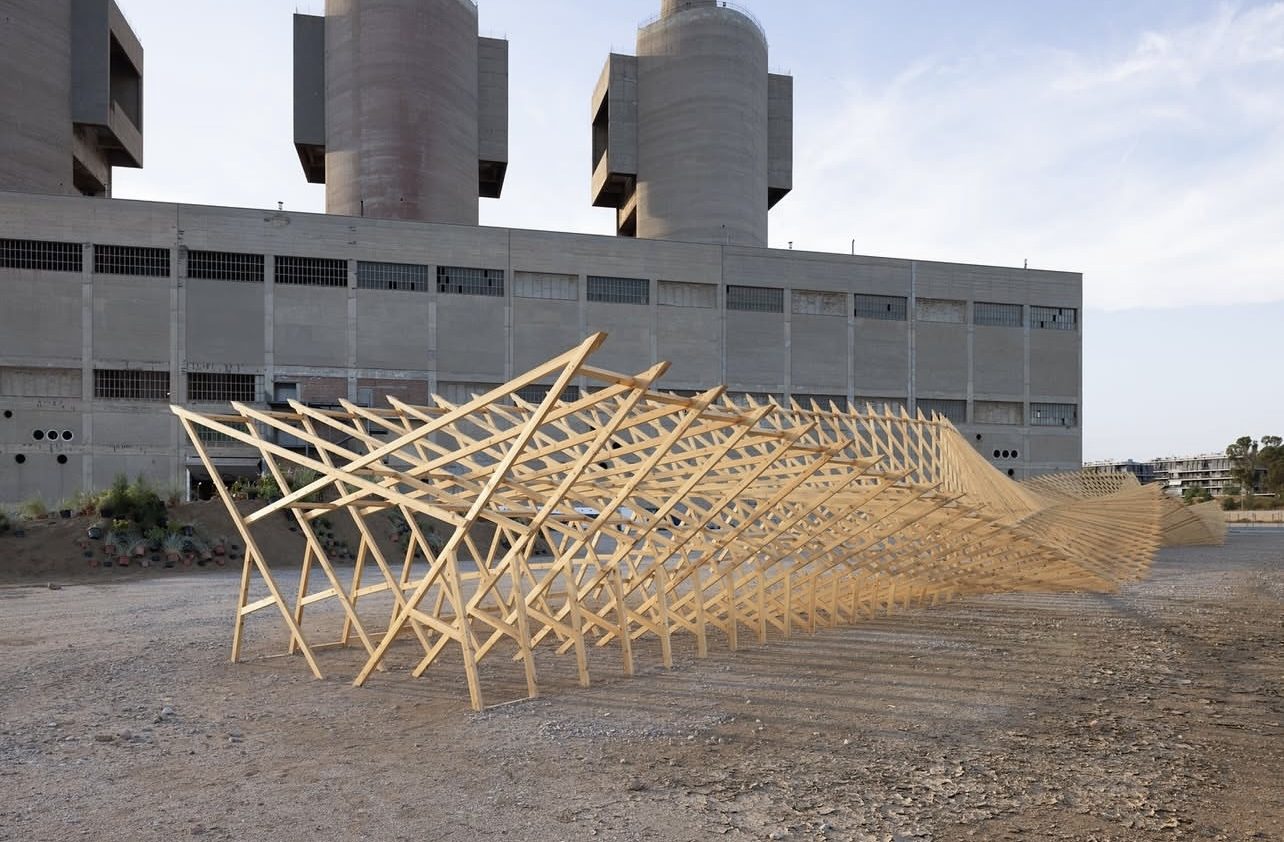
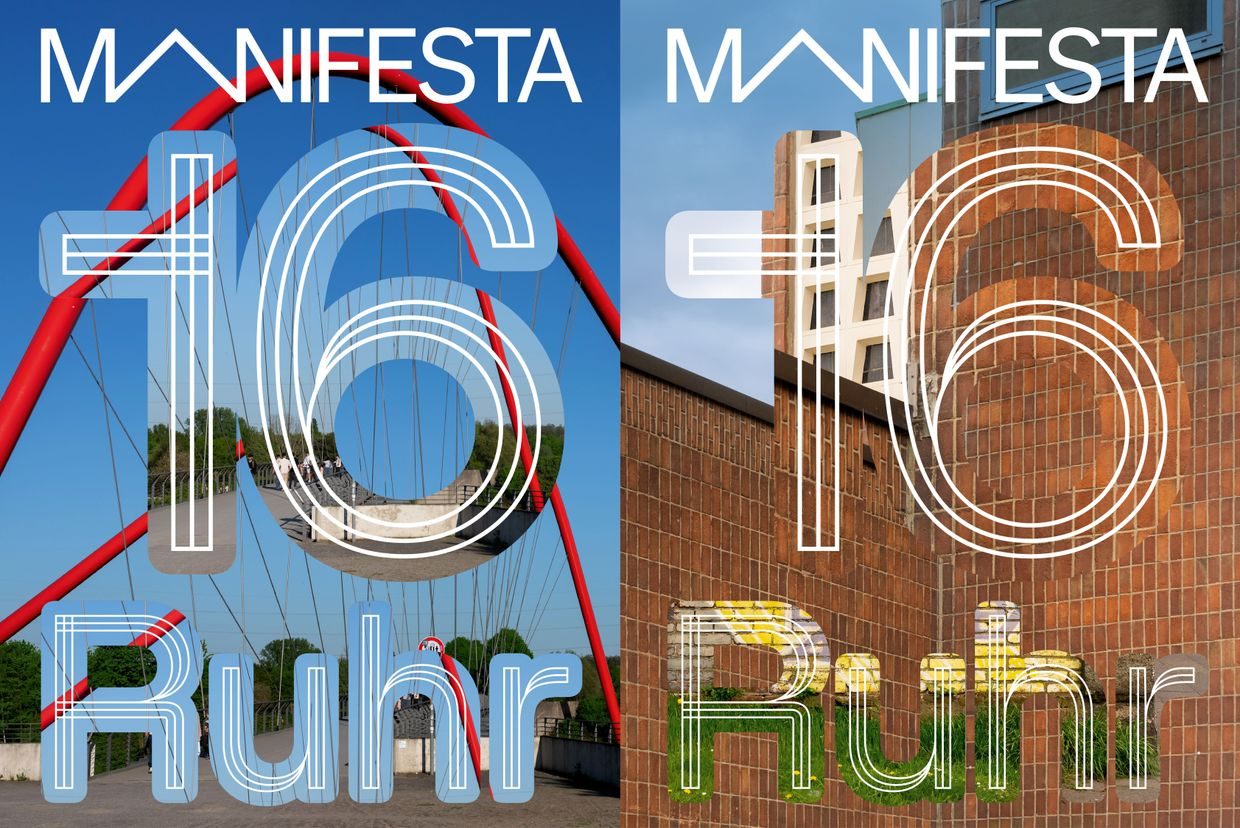
Images: (1) Manifesta 16 Ruhr visual identity, design by NODE Berlin Oslo. Courtesy of Manifesta 16. (2) Installation view, Wings X, 205-2024, Niels Albers. Photo: Manifesta 15 Barcelona Metropolitana, Ivan Erofeev.
MUSEUM OF CULTURE MILAN
November 19, 2025 – June 28, 2026
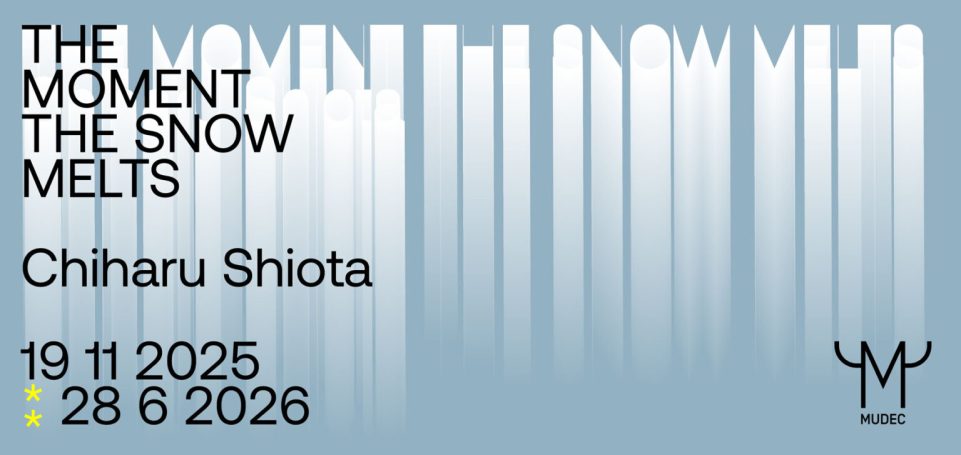
The Moment the Snow Melts
Chiharu Shiota
The Moment the Snow Melts is the site-specific installation by Chiharu Shiota (Osaka, 1972) presented at MUDEC as a prelude to the exhibition Il senso della neve (The Sense of Snow), opening in February 2026. Conceived for the museum’s Agora space, the work transforms the architecture into an evanescent landscape composed of countless vertical threads descending from the ceiling, evoking the delicate and transient presence of falling snow.
Suspended among these threads are notes and fragments of paper bearing the names of people who have been part of our lives but whom, for different reasons, we can no longer meet. Through this gesture, the installation becomes a collective field of memory, where individual stories converge into a shared meditation on absence, loss, and remembrance. From September onwards, visitors are invited to actively participate in the work by contributing their own thoughts or drawings on the theme, either by depositing them in a box within the museum or by submitting them digitally, allowing the installation to continuously evolve.
Shiota describes melting snow as a symbol of the final moments of something coming to an end: a last echo after a long silence, the retreat of a cold that once held everything in a firm grip. The ephemeral nature of snow serves as a metaphor for human relationships, which are formed, sustained, and eventually transformed by time. The threads represent bonds that may fade or loosen, often leaving behind feelings of longing, fragility, or sadness. Yet the names inscribed on paper affirm that what is lost is not erased; memory endures, and with it the possibility of renewal.
An opportunity to further explore Chiharu Shiota’s artistic practice is offered by the exhibition Chiharu Shiota: The Soul Trembles, presented at the MAO Museum of Oriental Art in Turin from 22 October 2025 to 28 June 2026. Curated by Mami Kataoka and Davide Quadrio, with curatorial support from Anna Musini and Francesca Filisetti, the exhibition brings together immersive installations, drawings, sculptures, and photographs that address universal themes of identity, memory, and human connection, transforming museum spaces into contemplative and emotionally resonant environments.
The Moment the Snow Melts is curated by Sara Rizzo with the support of 24 ORE Cultura.
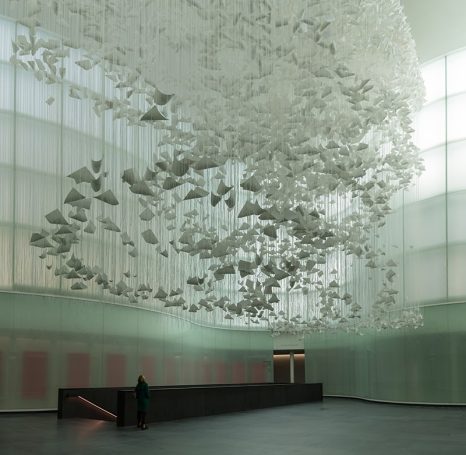
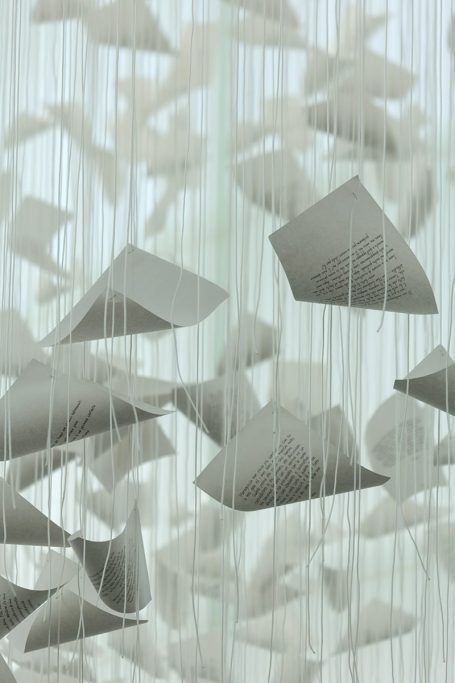
Chiharu Shiota, The Moment the Snow Melts, Installation view, 2025. Photos: Sara Rizzo. All images are courtesy of the artist and MUDEC © All rights reserved
FONDATION LOUIS VUITTON
October 17, 2025 – March 3, 2026
Major Retrospective
Gerhard Richter
From October 17, 2025 to March 3, 2026, the Fondation in Paris presents a major retrospective devoted to Gerhard Richter, one of the most influential artists of our time. Born in Dresden in 1932, Richter left East Germany in 1961, settling first in Düsseldorf and later in Cologne, where he lived and worked for many decades. His life and practice unfold across the fractures of postwar Europe, shaping an oeuvre marked by doubt, precision, and relentless inquiry.
Following its tradition of landmark monographic exhibitions dedicated to key figures of 20th- and 21st-century art, the Fondation devotes all of its galleries to Richter, whose work has profoundly reshaped the possibilities of painting. First presented at the Fondation’s opening exhibition in 2014, Richter is now honored with an exceptional retrospective of unprecedented breadth, bringing together 275 works created between 1962 and 2024.
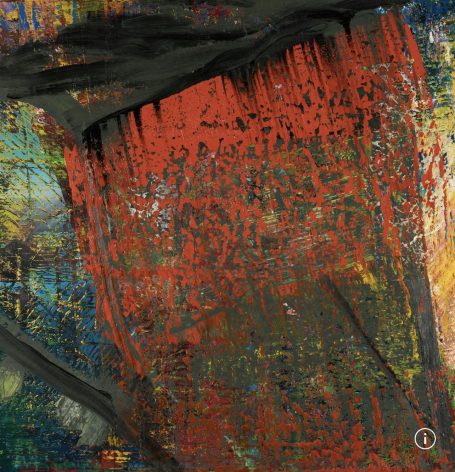
Spanning more than six decades, the exhibition assembles oil paintings, drawings, watercolors, overpainted photographs, and works in glass and steel. Together, they offer a comprehensive view of an artist who has consistently resisted stylistic certainty, moving between figuration and abstraction while questioning the very conditions of representation.
Rooted in classical genres—portrait, landscape, still life, and history—Richter’s practice reinterprets tradition through mediated images, often derived from photographs. His experimental use of tools, from brush to squeegee, reveals painting as both method and inquiry. Presented chronologically, the exhibition traces the evolution of a singular vision, shaped by tension between control and chance, memory and erasure, clarity and blur—an oeuvre defined by continuous transformation and an enduring commitment to the studio as a site of thought.
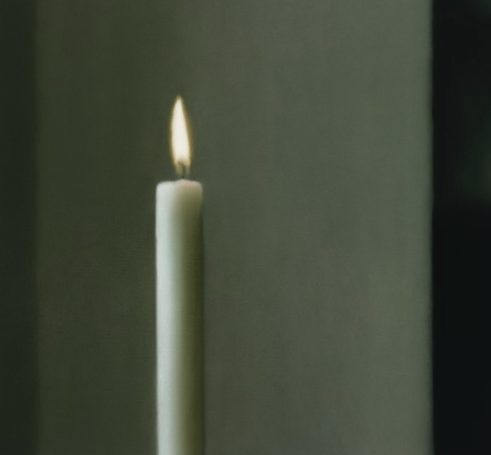
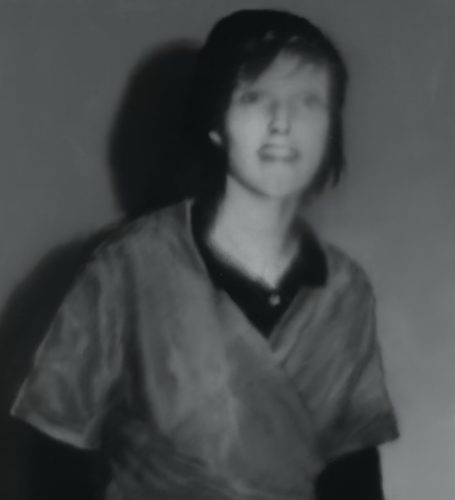
Credits: (1) Gerhard Richter, Gudrun, 1987 (CR 633) Fondation Louis Vuitton, Paris © Gerhard Richter 2025 (18102025). (2) Gerhard Richter, Kerze, 1982, Oil on canvas 90 x 95 cm, Institut d'art contemporain, Villeurbanne/Rhône-Alpes © Gerhard Richter2025 (18102025). (3) Gerhard Richter, Gegenüberstellung 2, 1988, Oil on Canvas, 112 x 102 cm, The Museum of Modern Art, New York. The Sidney and Harriet Janis Collection, gift of Philip Johnson, and acquired through the Lillie P. Bliss Bequest (all by exchange); Enid A. Haupt Fund; Nina and Gordon Bunshaft Bequest Fund; and gift of Emily Rauh Pulitzer, 1995. © Gerhard Richter 2025 (18102025)
XV FLORENCE BIENNALE 2025
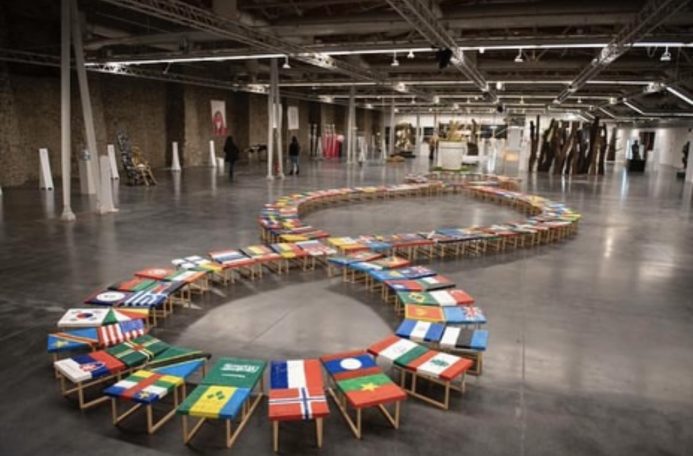
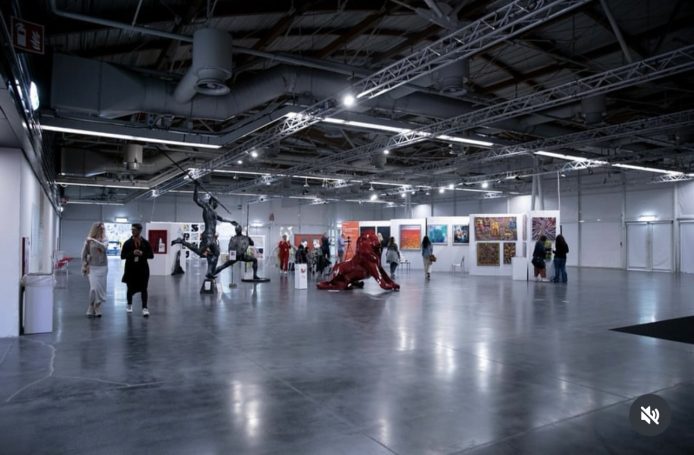
Images: (1) Installation view, Preventive Peace, Michelangelo Pistoletto at Palazzo Reale, 2023. Courtesy of the artist and Florence Biennale: (2) Exhibition view, Fortezza da Basso, courtesy of Florence Biennale.
October 18 – 26, 2025
Fortezza da Basso
The Sublime Essence of Light and Darkness
The XV Florence Biennale — the 15th International Exhibition of Contemporary Art and Design — took place from October 18 to 26, 2025, at the historic Fortezza da Basso in Florence, Italy. As one of the most significant global gatherings of contemporary culture, this edition brought together over 550 artists and designers from more than 85 countries, presenting more than 1,500 works across painting, sculpture, photography, multimedia, installation, design, and hybrid practices.
Under the curatorial theme “The Sublime Essence of Light and Darkness: Concepts of Dualism and Unity in Contemporary Art and Design,” the Biennale positioned itself as a platform for probing the foundational dichotomies of human perception and artistic expression. The theme invited reflection on how opposing forces — light and darkness, presence and absence, harmony and tension — coexist not as binaries but as intertwined phenomena that shape our understanding of reality, aesthetics, and cultural dialogue.
A major highlight of the 2025 Biennale was the conferment of the “Lorenzo il Magnifico” International Lifetime Achievement Award to American filmmaker and visual artist Tim Burton. Recognized for his distinctive cinematic and artistic vision, Burton’s work consistently challenges traditional perceptions by embracing the interplay of contrast — light and shadow, the uncanny and the poetic — as core components of creative expression. The award ceremony took place on October 21, 2025, at the theatre area within the exhibition spaces, acknowledging Burton’s profound influence on contemporary visual culture.
The XV Florence Biennale 2025 reaffirmed the event’s role as a rigorous, internationally respected forum for critical artistic engagement — one where the intersection of conceptual inquiry and aesthetic innovation continues to shape the global cultural landscape.
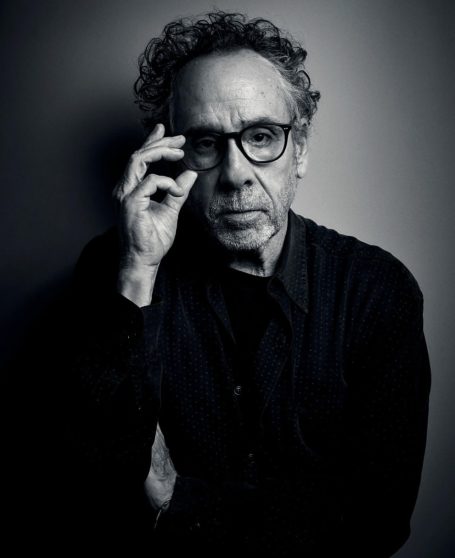
Images: (1) Lavinia de Rothschild, The Comfort of Collapse, at Florence Biennale 2025. (2) Tim Burton, Lifetime Achievement Award at the XV Florence Biennale 2025. Photo: Steve Schofield. All images are courtesy of the artists and Florence Biennale © All rights reserved
SITE SANTA FE
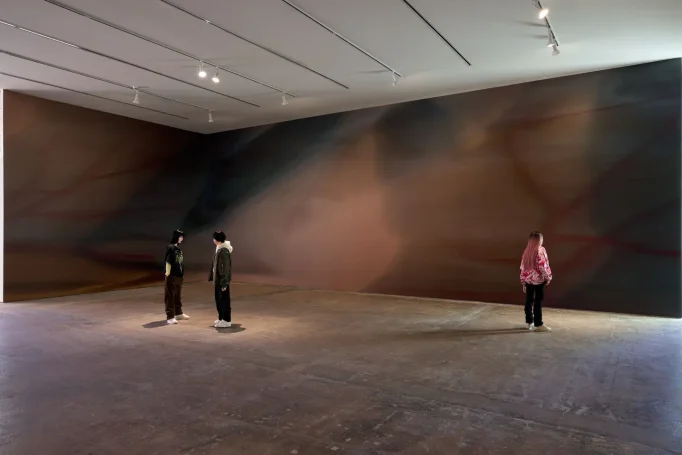
Installation view, Gisèle Vienne and Louise Lawler. Photo by Brad Trone. Courtesy of SITE SANTA FE.
June 27, 2025 – January 12, 2026
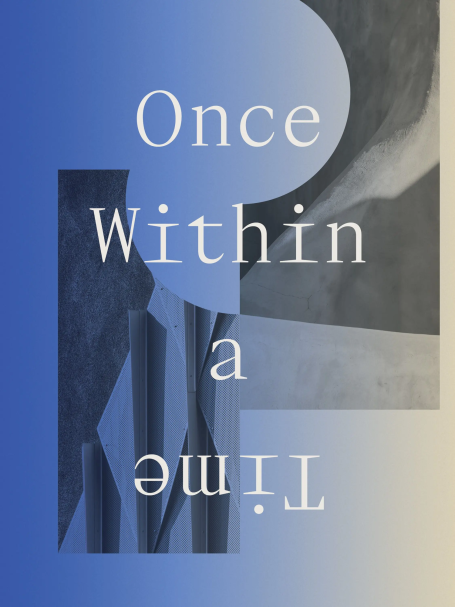
Once Within a Time
12th SITE SANTA FE International
Once Within a Time borrows its title from the recent film by Godfrey Reggio, whose visionary practice has long unfolded in Santa Fe. Released in 2022, the film weaves together elements of fable and catastrophe, shaping a contemplative language where the imaginary and the everyday coexist. Drawing from this circular approach to storytelling, the 12th SITE SANTA FE International places narrative at its core, unfolding New Mexico’s layered histories through the perspectives of more than ninety participating artists.
At the center of the exhibition is a constellation of over twenty figures intimately connected to the Southwest. These individuals—ranging from cultural icons and legendary presences to quiet inhabitants, writers, artists, and healers—form the narrative spine of the project. Their lives and stories, reflected through archives, objects, images, and documents, serve as points of departure for more than seventy artists working locally and internationally. Many have produced new commissions in response to these encounters, presented alongside contemporary works from across the globe.
For the first time, the International expands beyond SITE SANTA FE, activating more than a dozen venues throughout the city. Museums, historical sites, public parks, former industrial spaces, storefronts, and unexpected interiors become stages for artistic exchange. This dispersed geography encourages visitors to navigate Santa Fe as both setting and subject, where place and story continuously intersect.
Conceived as an expansive family album, Once Within a Time foregrounds the people who have shaped, crossed, and imagined Santa Fe over generations. Rather than following a single narrative thread, the exhibition unfolds as a polyphonic gathering—an open archive of voices, memories, and myths that collectively reflect the city’s complex cultural fabric.
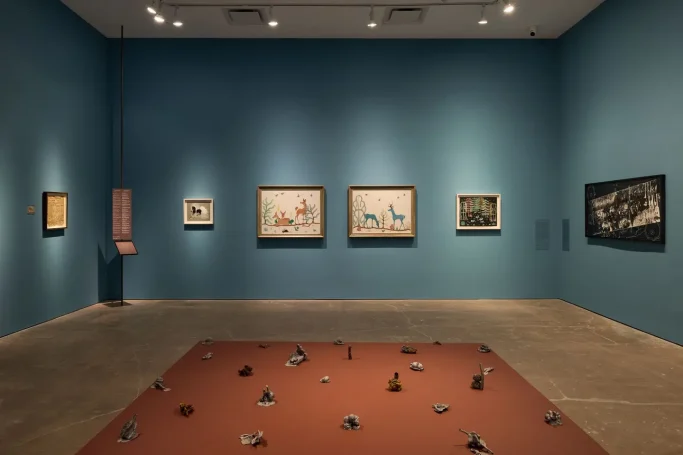
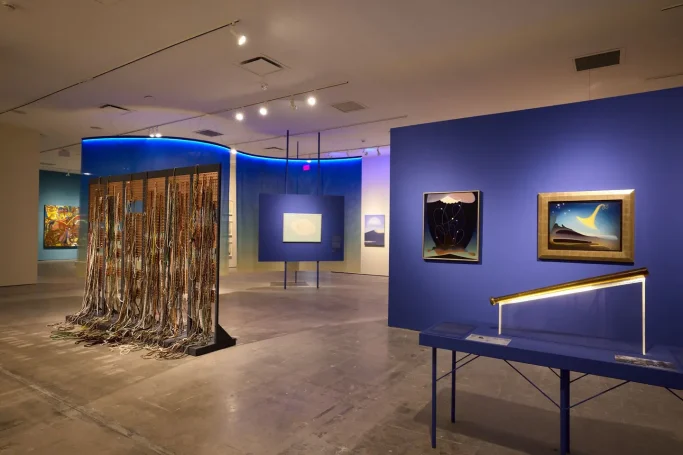
Images: (1) Installation view, Willa Cather, Pop Chalee (Merina Lujan), Zhang Ruyi, and Maureen Gruben. Photo by Brad Trone. (2) Installation view, 12th SITE SANTA FE International: Once Within a Time, 2025. Photo by Brad Trone. All images are courtesy of the artists and SITE SANTA FE © All rights reserved